Our projects
Sector
Aeronautics
Expertise
Monitoring & control
Automating the quality control of acoustic panels using artificial intelligence
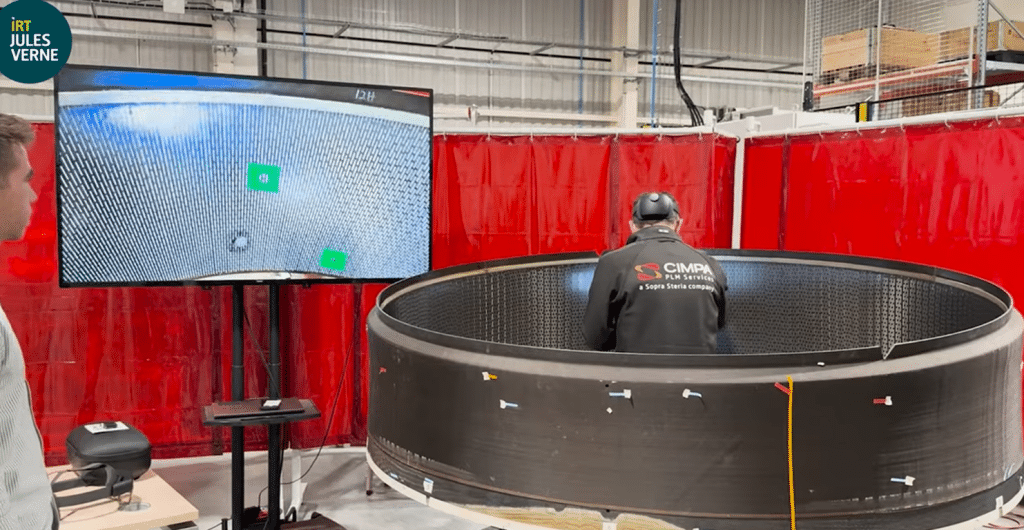
For Airbus Atlantic, IRT Jules Verne has developed an automated visual inspection solution combining non-destructive testing and artificial intelligence to detect cosmetic defects in air inlet parts.
Led by
 With
With

With
"Acoustic panels" R&T service at a glance
- Acoustic panels, which are visible elements of aircraft air intakes, must meet strict cosmetic criteria for scratches, dents and surface defects. Until now, this inspection was carried out manually by the operators, for a time considered to be of little added value.
- Airbus Atlantic asked IRT Jules Verne to automate this quality control. Mobilizing its expertise in non-destructive testing and artificial intelligence, IRT Jules Verne has designed an automated visual inspection solution integrating machine learning models capable of precisely identifying these cosmetic defects. Three technological bricks have been developed as part of this service.
01
CHALLENGES
R&T service challenges
- Replace time-consuming, low-value-added manual inspection with automated control.
- accurately detect cosmetic defects (scratches, dents, surface defects) on air inlet parts;
- make quality control more reliable while optimizing production times;
- Validate the solution on real parts, in industrial conditions, before a possible integration into the production line.
02
developed solutions
The solution developed by IRT Jules Verne
Thanks to its expertise in non-destructive testing and artificial intelligence, IRT Jules Verne has designed an automated solution for visual inspection of acoustic panels:
- design of an automated visual inspection solution integrating machine learning models;
- development of three technological bricks dedicated to the precise identification of cosmetic defects;
- mobilization of IRT Jules Verne's expertise in monitoring, control and artificial intelligence.
03
Results & impacts
Results and impacts for Airbus Atlantic
- the solution has been successfully tested on real parts, under industrial conditions;
- Airbus Atlantic plans to integrate this technology into production within two years;
- a gain in competitiveness is expected thanks to the automation of quality control;
- production times are optimized and the environmental impact of the inspection is reduced.
partners voices
“The impact of this work is highly significant for Airbus Atlantic. We tested the solution on real products under conditions close to an industrial environment. Our aim is to bring this computer vision technology for cosmetic defect detection into production within the next two years.”Find out more
04
Industrial perspectives
The perspectives of the R&T service
Towards production line integration
Airbus Atlantic plans to integrate this automated visual inspection solution into production within two years, with a gain in competitiveness and a reduction in production times.
What's next? extending AI to industrial quality control
This service illustrates the know-how of IRT Jules Verne in terms of monitoring, control and artificial intelligence, which can be used for other automated quality control applications in industry.
find out more
You might find this content of interest.
 Expertise
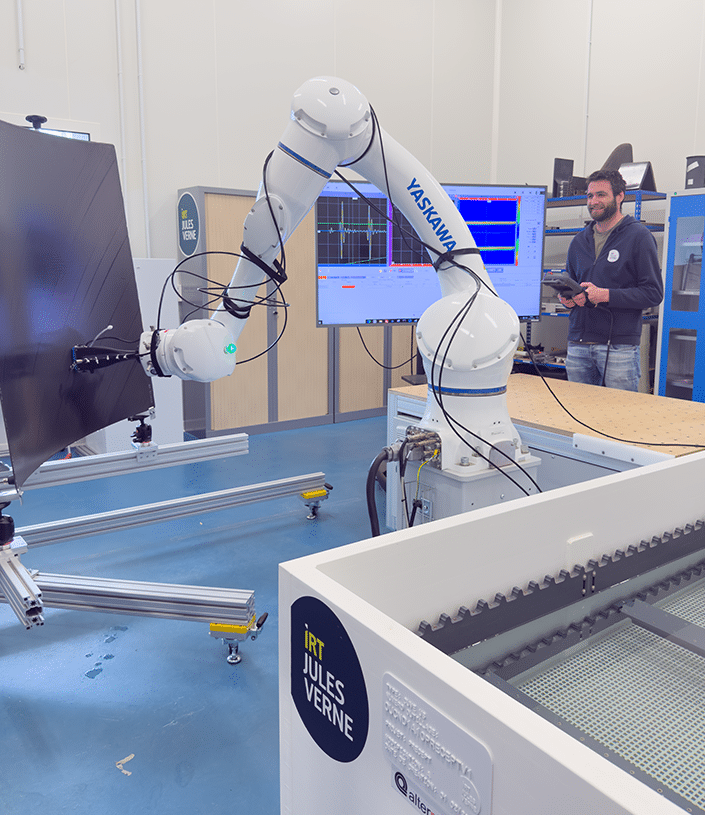
Process monitoring, inspection and control
Develop non-destructive testing of critical parts and monitor manufacturing processes to reduce production costs.
Discover this expertise
Expertise
Process monitoring, inspection and control
Develop non-destructive testing of critical parts and monitor manufacturing processes to reduce production costs.
Discover this expertise
 Offre
Entrust your manufacturing R&D projects to us
Find out more about this offer
Offre
Entrust your manufacturing R&D projects to us
Find out more about this offer
 Sector
Technology transfer
Find out more about this course
Sector
Technology transfer
Find out more about this course
 Sector
Aeronautics
Find out more about this course
Sector
Aeronautics
Find out more about this course