
Developing Cable-Driven Parallel Robots to Automate Operations in Large Industrial Spaces
The TITANBOT project is developing a new generation of Cable-Driven Parallel Robots to automate complex tasks in the construction, nuclear and industrial sectors.
 With
With






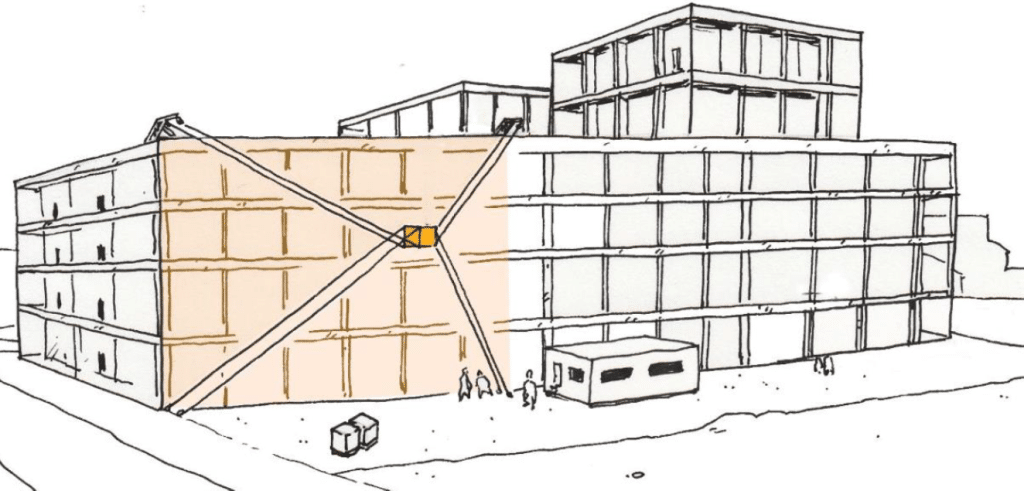
- Launched as part of the France 2030 "Robotic Transfer" Challenge, the TITANBOT project brings together the CNRS (LS2N and LIRMM), IRT Jules Verne, Actemium, Cetim, Orano and VINCI Energies around a common objective: to develop driven-cable parallel robots capable of automating operations carried out in large volumes of work.
- The project aims to transfer technologies from several years of research to industry in order to offer more flexible, easy-to-deploy robotic systems adapted to the complex environments of construction, industry and nuclear.
The industrial challenges of the TITANBOT Project
Many industry sectors still need to perform manual operations in large, complex, or operator risk environments.
The TITANBOT project responds to several major challenges:
- Automate tedious or dangerous tasks in large volumes of work.
- Facilitate the movement of materials and tools in complex environments.
- transfer technological building blocks resulting from collaborative research to industry;
- Develop robotic solutions that can be easily deployed on industrial sites.
Building on the work carried out by LS2N, LIRMM and IRT Jules Verne, TITANBOT aims to accelerate the integration of parallel cable robots into industrial uses.
Technologies developed for Cable-Driven Parallel Robot
The TITANBOT project is based on several technological developments aimed at making Cable-Driven Parallel Robot fully operational:
- development of demonstrators capable of operating in autonomous and coactive modes;
- development of software for the design of Cable-Driven Parallel Robot;
- implementation of control laws guaranteeing speed, precision and operator safety;
- development of methods for calibrating mechanical parameters;
- Improving the ergonomics and acceptability of robots through models for predicting human behavior and adapted human-machine interfaces.
The project also relies on the test facilities of the IRT Jules Verne in order to accelerate the industrial transfer of the technologies developed.
Targeted industrial applications
The TITANBOT project is developing demonstrators that meet concrete industrial needs.
Construction
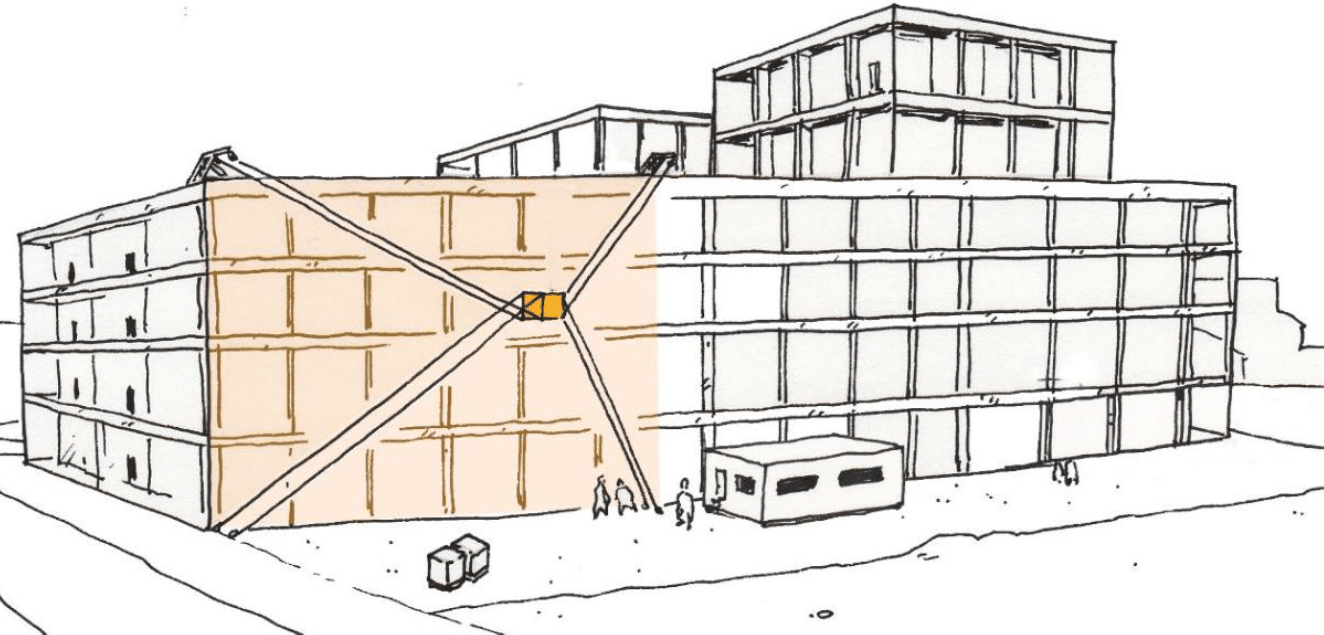
For VINCI Energies, the project aims to automate the transport of equipment to the floors of a building under construction using a mobile skip capable of automatically discharging its contents onto a secure platform. The system is designed to be easily dismantled and reassembled in order to follow the different phases of a construction site.
Nuclear
For Orano, TITANBOT is developing a solution to automate the radiological monitoring of the walls of a nuclear facility in order to confirm its decommissioning before dismantling and decontamination operations.
The industrial prospects of cable-based parallel robotics
Applications beyond research laboratories
The TITANBOT project aims to accelerate the transfer of parallel cable robots to industrial sites.
The technologies developed meet the needs of several sectors:
- construction;
- industry;
- nuclear;
- logistics.
By relying on demonstrators on a representative scale, the project aims to facilitate the integration of these robotic solutions in industrial environments.
What's next? Towards the industrialization of Cable-Driven Parallel Robots
TITANBOT is a continuation of several collaborative projects carried out between IRT Jules Verne, LS2N and LIRMM around parallel cable robots.
The project should make it possible to mature the technologies developed in the laboratory in order to accelerate their transfer to industry. It also opens up new perspectives for the IRT Jules Verne in the nuclear, civil engineering and industry sectors of the future.
You might find this content of interest.
 Expertise
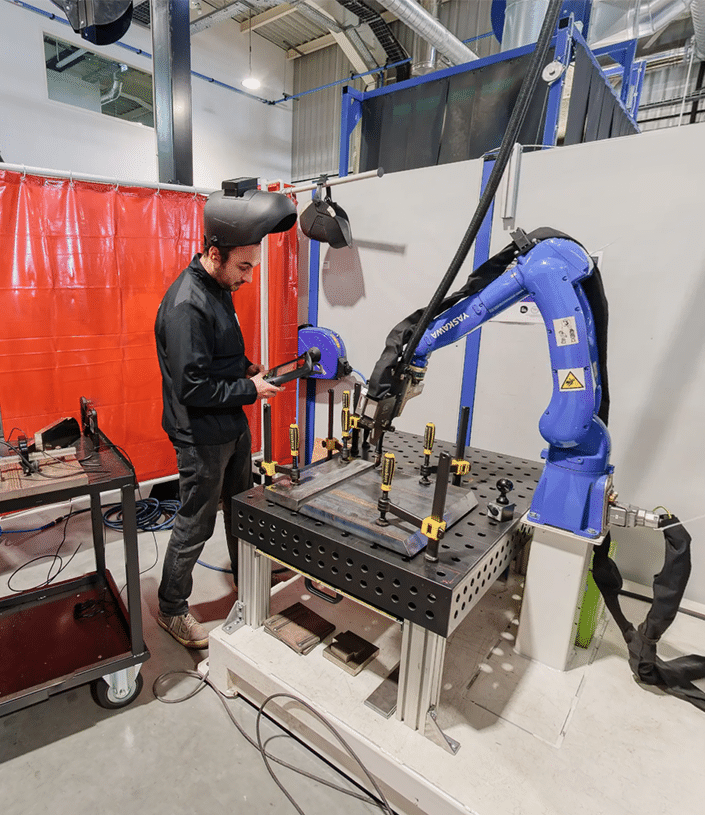
Robotics & Cobotics
Automating processes and optimising the deployment of robots in complex industrial environments
Discover this expertise
Expertise
Robotics & Cobotics
Automating processes and optimising the deployment of robots in complex industrial environments
Discover this expertise
 Offre
Responding effectively to strategic national calls for proposals for industry
Find out more about this offer
Offre
Responding effectively to strategic national calls for proposals for industry
Find out more about this offer
 Sector
Construction
Find out more about this course
Sector
Construction
Find out more about this course
 Sector
Energy
Find out more about this course
Sector
Energy
Find out more about this course