
Controlling the TIG process in additive manufacturing: an innovative demonstrator at IRT Jules Verne
How can we ensure the geometric conformity of complex parts produced using TIG additive manufacturing?
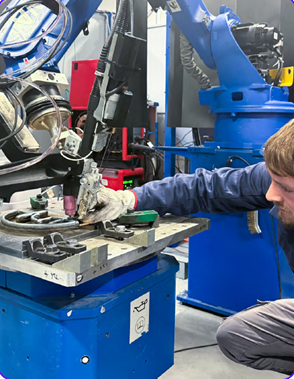
Engineers at IRT Jules Verne have addressed this question through a dedicated demonstrator, developed by the Metallic Materials Processes, Robotics and Cobotics, and Monitoring, Inspection and Control teams.
The challenges: managing singularities in WAAM TIG
Electric arc additive manufacturing (WAAM TIG) is a promising technology for producing large-scale metal components.
However, in order to make this process suitable for industrial use, it is necessary to increase its productivity and quality (geometric, mechanical properties, etc.) and to ensure its reliability.
By combining the expertise of its PMM, ROC and MIC teams, IRT Jules Verne contributes on a daily basis to advancing the maturity of this process for additive manufacturing applications. Within the scope of this demonstrator, geometric quality was at the heart of the challenge, particularly at points of singularity (end of the weld bead, changes in direction, etc.) where the geometry can vary significantly. These variations compromise the quality of the final parts and reduce the process’s productivity by necessitating multiple passes to achieve the final geometry.
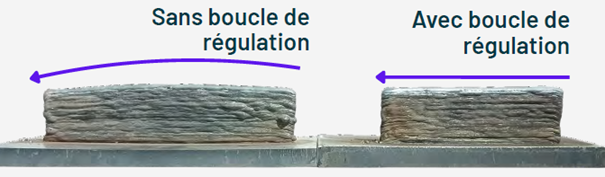
The objective of this demonstrator was clear: to implement a control loop to stabilise the process and achieve consistent, compliant geometries without the need for rework or compensation, even in complex configurations.
The approach: combining experimentation with real-time monitoring
Thanks to our expertise in additive manufacturing based on arc technologies, we understand the influence of various process parameters on weld bead geometry for different configurations (changes in direction, intersecting beads, overlapping beads, etc.). Furthermore, unlike MIG/MAG technologies, the TIG process introduces an additional layer of complexity due to the position of the wire and its control in relation to the arc.
Drawing on our expertise in robotics, a control algorithm has been implemented to regulate process parameters in real time, with the aim of ensuring a constant deposit height and, consequently, geometric conformity.
This control system was tested and validated on simple walls, then on more complex geometries (bends, crossings, overlaps), representative of the geometric challenges that may be encountered on industrial products.
The results: a control loop has been implemented to ensure robust geometric compliance for the FA WAAM TIG
- A variation of less than 1 per cent in height compared with the target value on a wall
- A variation of 2 per cent in height compared with the target value on a complex shape
The outlook
- Extend the control loop to other arc welding processes (MIG/MAG, plasma, etc.)
- Extend this loop to other process parameters for other quality criteria (overall geometry, microstructure, etc.)
- Use this feedback loop in TIG welding to ensure the conformity of weld beads and facilitate the automation of the TIG welding process
Over to the engineers: complementary areas of expertise
Sébastien Galisson – R&D Engineer, Metallic Materials Processes Team
“My role was to define the process parameters that directly influence the geometry of the weld beads in TIG additive manufacturing. The challenge was to establish a process window capable of covering all possible variations in order to implement robust control and thus ensure the geometric conformity of the part.”
Benyamine Allouche – R&D Engineer, Robotics and Cobotics Team
“My role was to translate the technical expertise of the Metallic Materials Processes team into dynamic behaviour that accurately represents the system. I was involved in the development and implementation of a real-time control loop for the robotic welding station. This control system enables precise and responsive control of process parameters and was achieved through close multidisciplinary collaboration between the various teams at IRT Jules Verne.”
Matthieu Piniard – Engineer, Monitoring, Inspection and Control Team
“I helped to monitor and analyse process signals to guide the identification of the controller parameters. Monitoring is essential to ensure that the control system is functioning correctly and thus to validate the controller’s performance.”
Multidisciplinary collaboration driving innovation
This demonstrator illustrates the added value of combining multiple areas of expertise within IRT Jules Verne. The Metallic Materials Processes, Robotics and Cobotics, and Monitoring, Inspection & Control teams worked together to tackle this technical challenge and demonstrate the feasibility and benefits of closed-loop control in TIG additive manufacturing.
Beyond the results achieved, this approach paves the way for new development opportunities. The solution developed can serve as a basis for more ambitious projects, aimed at exploring other configurations, materials or production environments.
By building on this initial proof of concept, it becomes possible to envisage future collaborative projects centred on control systems for additive manufacturing, with a view to accelerating the maturation and industrial transfer of these technologies.
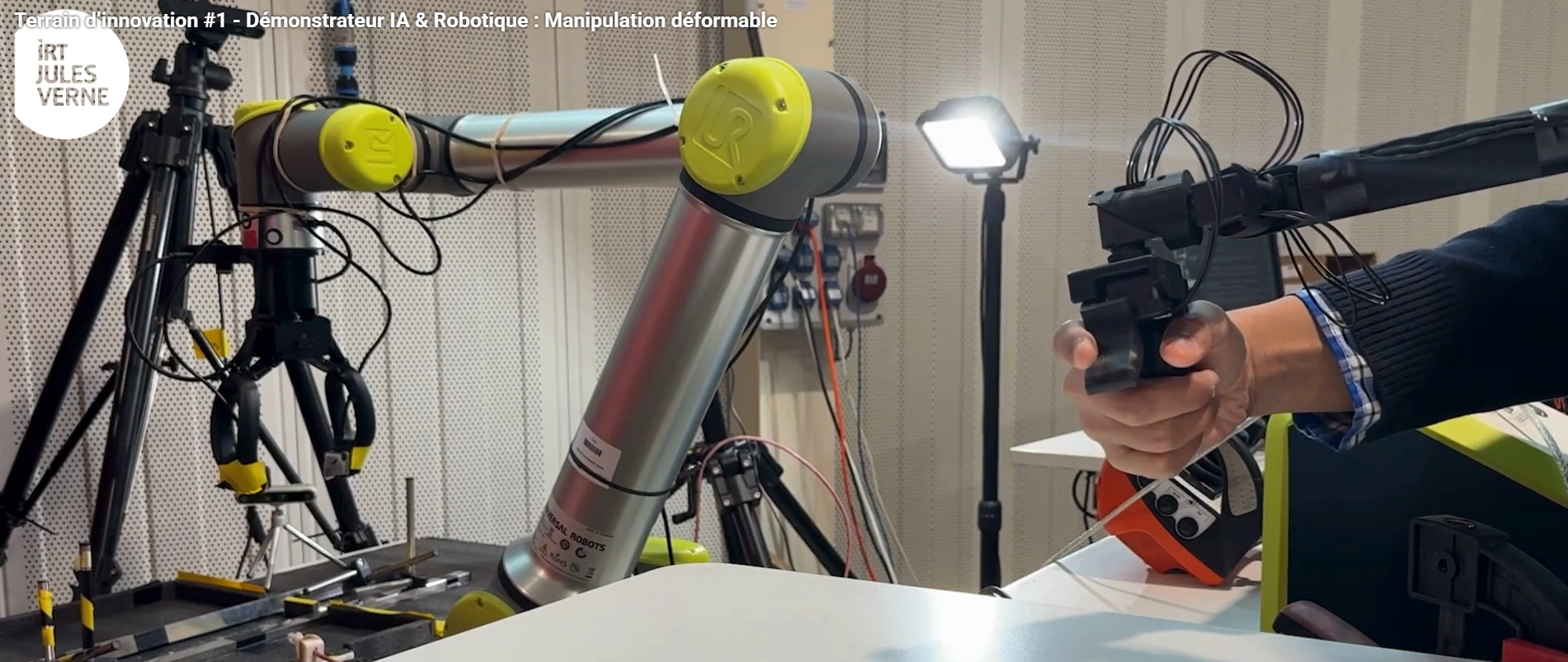
Watch the video showing the process: