
Use of AI for the robotic manipulation of linear deformable objects
How can a robot be enabled to reliably handle soft and deformable objects, such as cables or harnesses, whilst meeting industrial requirements for precision, robustness and repeatability?
The Robotics & Cobotics team at IRT Jules Verne has tackled this challenge by developing a demonstrator dedicated to the use of artificial intelligence for the robotic handling of deformable linear objects (DLOs). This demonstrator forms part of an internal research initiative aimed at anticipating future industrial needs, particularly in the fields of cabling, assembly and the handling of complex components.
The challenges: dealing with the unpredictable
Deformable linear objects present a major challenge for industrial robotics. Unlike rigid parts, their behaviour is difficult to predict: they deform continuously, can obscure themselves and can only be controlled indirectly, via their ends. A local action can have non-linear global effects on the entire object.
Under these conditions, conventional robotic approaches – based on manual trajectory programming and a strict decomposition of functions (perception, planning, control) – quickly reach their limits as soon as the task requires dexterity, adaptability and significant interaction with the environment.
To overcome these technological barriers, the IRT Jules Verne is exploring new AI-based approaches capable of partially circumventing the need for complex analytical modelling of these objects, whilst remaining compatible with practical industrial applications.
The approach: learning the movement rather than programming it
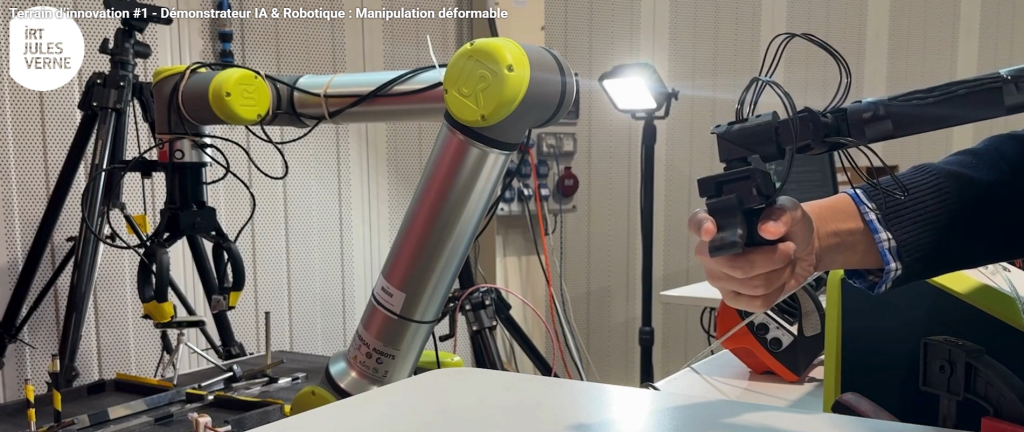
The demonstrator is based on a different approach: rather than programming each step, the robot learns the movement by observing human demonstrations.
The use case studied involves installing a cable on a panel, including connection and cable ducting operations. This deliberately challenging scenario is representative of many industrial situations where the precise handling of flexible objects remains difficult to automate.
The robot learns by observing the operator’s movements, combining these with data from its sensors. High-resolution cameras and GelSight tactile sensors enable it to accurately perceive the shape and behaviour of the objects being handled.
This data then feeds into an offline learning phase, during which state-of-the-art imitation learning models are trained to enable the robot to reproduce and adapt these gestures to similar situations. Finally, a real-world optimisation phase enables the robot to perform the task and gradually improve its behaviour, in a semi-supervised setting, in order to become more robust and adaptable.
Tangible results in real-world conditions
The work carried out has validated a complete AI-driven robotic manipulation workflow, from simulation through to deployment on a real robotic cell at the IRT Jules Verne. Evaluation campaigns were conducted to compare different imitation learning architectures on tasks involving rigid and deformable objects, and to measure their performance under real-world conditions.
These experiments demonstrated that end-to-end approaches enable complex manipulation behaviours to be achieved – behaviours that are difficult, if not impossible, to reproduce using conventional robot programming methods. The demonstrator is capable of handling situations involving self-occlusions, multiple contacts and configuration variations, whilst maintaining a level of motion consistency and reproducibility compatible with a pre-industrial context.
Beyond the performance observed, this work has enabled IRT Jules Verne to consolidate operational expertise on the conditions required to stabilise these models: scene configuration, choice and positioning of sensors, adjustment of critical parameters, and a detailed understanding of the current limitations of state-of-the-art solutions. This knowledge is essential for assessing the true maturity of these approaches with a view to industrial transfer.
“This demonstrator has enabled us to clearly identify not only what current AI approaches are capable of, but also what still needs to be improved in order to achieve the level of robustness required in an industrial environment,” says Mark Bastourous, a robotics engineer at IRT Jules Verne.
Tangible results for industrial applications
This demonstrator now forms a key technological building block for the IRT Jules Verne’s work in robotics and cobotics. It paves the way for numerous industrial applications, such as complex cabling, the production of electrical harnesses, the handling of composites, and the rapid programming of robots through demonstration.
Future research will focus in particular on improving robustness in the face of real-world disturbances, exploring new architectures suited to long and complex tasks, and optimising data collection interfaces to speed up learning cycles. The aim is to gradually align these research-based approaches with the requirements for reliability, repeatability and transferability expected on production lines.
With this demonstrator, IRT Jules Verne demonstrates how it anticipates developments in industrial robotics, tests new approaches under real-world conditions and transforms technological advances into practical demonstrators to meet industrial needs.
Découvrez la vidéo du démonstrateur en action :