
IRT Jules Verne alongside CERO: supporting a regional SME in optimising its processes
Based in Challans, in the Vendée region, CERO has been designing and developing tooling for the plastics and composites industries for over 40 years. With more than 40 employees and operations focused on production, exports and R&D, this SME works on projects with high technical demands, where the reliability of processes is a key consideration.
Against this backdrop, CERO called upon the IRT Jules Verne for two separate services, drawing on its expertise in Metallic Materials Processes (PMM) and Simulation and Modelling (SIM). Two different challenges, but a shared objective: to secure and develop specific industrial processes, by relying on a partner at the cutting edge of production technologies.
Clearly identified industrial needs
Improving the reliability of welded assemblies on jigs and fixtures
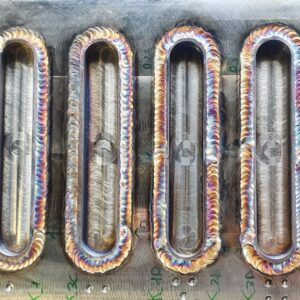
The first assignment follows on from leakage issues observed on certain jigs. These defects may affect the quality of the parts produced and require a detailed analysis of welding practices and the parameters used.
For CERO, the challenge is twofold: to understand the cause of the observed issues and to quickly identify areas for improvement that can be implemented on the shop floor.
Mastering the thermal management of a composite stamping process
The second service forms part of a stamping process for components made from thermoplastic matrix composites.
This type of process requires rigorous control of thermal conditions in order to guarantee the quality of the components produced and industrial repeatability.
As part of a strategic R&D project for CERO, the challenge was to gain a better understanding of the process’s overall behaviour and to identify areas for optimisation that were compatible with industrial constraints.
CERO therefore approached IRT Jules Verne to seek support with numerical simulation, in order to inform technical decisions and ensure the right direction for development.
Two services, the same approach to support
On-the-ground support, working closely with the teams
For the first welding-related assignment, the Processes and Metallic Materials teams at IRT Jules Verne worked directly on site at CERO, in close collaboration with the on-site operators.
“The main aim was to gain a precise understanding of what was happening on the ground, both in terms of the welding process itself and how it was being carried out by CERO staff,” explains Thomas Dallet, a research engineer at IRT Jules Verne
"We observed the practices, carried out welding tests and characterised representative parts. This understanding of the manufacturing and inspection chain is essential for proposing realistic solutions tailored to industrial constraints.”
The project drew on the expertise of an IWE-certified welding engineer, as well as destructive and non-destructive testing methods to analyse the joints produced.
Simulation to inform technical decisions
At the same time, the Simulation and Modelling teams carried out a numerical study of the process to analyse its overall thermal behaviour.
“Simulation provides an objective insight into the physical phenomena at play and supports technical decision-making during the development phases,” emphasises Yvan Denis, a research engineer at IRT Jules Verne.
The use of simulation has also made it possible to minimise the need for complex and costly experimental tests, whilst maintaining a high level of reliability in the analysis.
Concrete and immediately actionable results
On improving the reliability of tooling:
- Identification of the causes of sealing issues through on-site intervention;
- Characterisation of components and analysis of test results;
- Proposal of technical solutions to improve the quality and robustness of welds.
This work made it possible to resolve certain issues quickly, whilst providing lessons that can be applied to similar problems in the medium term.
On mastering thermal management:
- Analysis of overall performance;
- Identification of areas for improvement;
- Evaluation of optimisation scenarios compatible with industrial roll-out;
- Support for decision-making in the context of strategic development.
The results and recommendations provided by IRT Jules Verne can be directly incorporated into CERO’s projects, either to complement them or as a follow-up to ongoing developments.
Different perspectives on effective collaboration
“We had two very distinct challenges, but they had one thing in common: the need to make our processes safer without placing an excessive strain on our own resources. IRT Jules Verne provided us with a high-level external perspective, both on the ground and through simulation. These are concrete results that we can actually put to use in our projects.” - Jean-Michel Deck, Business Development Manager – CERO
“With this type of service, our role is to provide expertise whilst remaining pragmatic. We work on very practical production issues, with immediate challenges relating to quality and reliability. The aim is not to over-complicate matters, but to help make our clients’ existing processes more reliable so that they themselves can deliver high-quality results.” - Thomas Dallet, ingénieur de recherche – IRT Jules Verne
“The role of simulation in this type of project is to provide an in-depth understanding of the process’s overall behaviour, in order to support the client in their technical decisions. In innovative development contexts, this approach helps to validate the chosen direction whilst reducing industrial risks and the costs associated with the testing phases.” Yvan Denis, ingénieur de recherche – IRT Jules Verne
IRT Jules Verne is committed to supporting the regional industrial base
These two projects illustrate the role of IRT Jules Verne as a local technology partner, capable of supporting industrial SMEs on specific issues by combining practical expertise with advanced digital tools.
They also demonstrate IRT Jules Verne’s commitment to working with and for local stakeholders, by providing solutions tailored to industrial realities and by promoting local skills.