
Optimising the fine-tuning of cold forming
The simulation team at IRT Jules Verne is supporting Naval Group with the simulation of forming processes
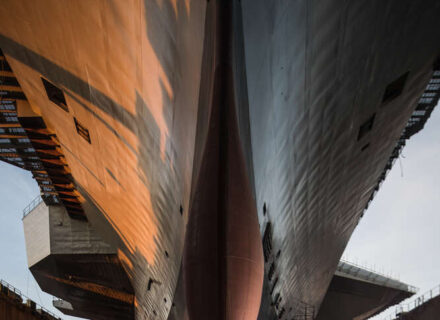
Supporting the development of industrial processes through numerical simulation
As a major industrial player in the naval defence sector, Naval Group designs, builds, integrates, maintains, decommissions and dismantles submarines and surface vessels for the French Navy and other navies around the world. The group combines expertise in cutting-edge technology, specialised and rare industrial know-how, and a strong culture of innovation. Its world-class production capabilities are constantly being improved. Committed to a continuous process of innovation, Naval Group is collaborating with IRT Jules Verne to advance its industrial processes.
Naval Group is developing numerical simulation to support the implementation of cold forming. IRT Jules Verne is supporting the naval group by developing a decision-support tool based on the simulation of cold forming of thick sheet metal. This project demonstrates IRT Jules Verne’s ability to harness its expertise in numerical simulation and applied mathematics to benefit complex processes and to support the evolution of its partners’ industrial practices.
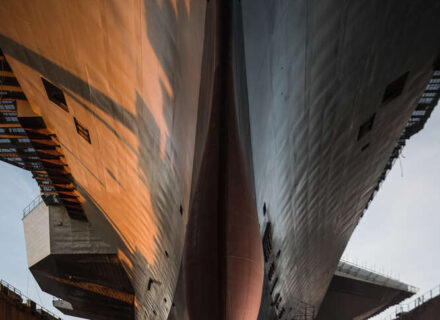
A need for a tool to facilitate the implementation of forming processes
Naval Group carries out cold-forming operations on large, thick metal sheets.
The aim of the project carried out by IRT Jules Verne was to produce a proof of concept for a tool that facilitates decision-making when defining tooling and forming parameters, in order to speed up the process of fine-tuning the conditions for deep-drawing.
“The aim of this project was to take a step towards utilising the results of the digitisation of manufacturing processes to complement human expertise,” emphasises an R&D engineer at Naval Group’s Centre of Expertise for Naval Structures and Materials (CESMAN). “The tools developed by IRT Jules Verne help us to better understand the impact of the various process parameters on the shaping outcome.”
A metamodel to support industrial decision-making
IRT Jules Verne has drawn on its expertise in process simulation and applied mathematics to design a metamodel capable of rapidly proposing process parameters for cold forming.
Taking a single-pass cold stamping configuration as a basis, the work was organised into three successive phases:
- Simulation of the reference case, to establish the numerical behaviour of the process;
- Development of the experimental design and construction of the metamodel, incorporating a sensitivity analysis;
- Development of a tool to assist with the definition of process parameters, designed for direct use in the field.
The final tool delivered enables the calculation of several critical process parameters, such as curvature after elastic recovery, maximum residual stress or forming force, and allows the effects of input parameters on the final result to be visualised quickly.
“This type of development perfectly illustrates the added value of simulation when it is conceived as a decision-support tool,” explains Olivier Valentin, an R&D engineer in the Simulation team at IRT Jules Verne. “As with most of our collaborations, we worked closely with the teams at Naval Group to design an optimised solution: a robust, user-friendly tool tailored to their production requirements.”
A long-term, forward-looking partnership
This project forms the preparatory stage for a future collaborative initiative aimed at broadening the scope of the processes under study and increasing the use of numerical simulation in shipbuilding projects. It builds on a long-standing collaboration between Naval Group and IRT Jules Verne, based on the sharing of expertise and mutual trust.